
a ramadan special
w/ love from amman, jordan

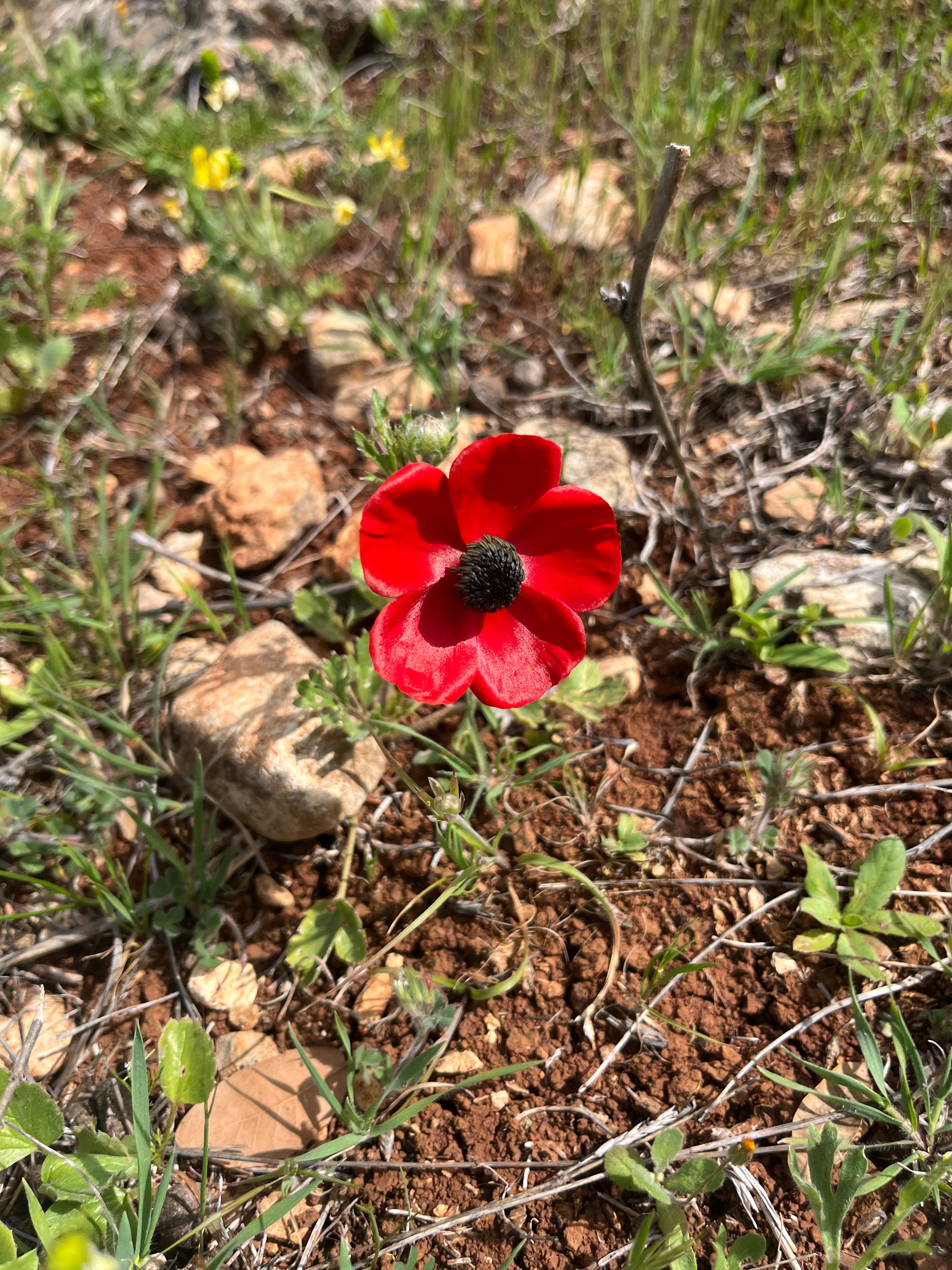
it’s poppy season :)
Hello! It’s me, Alia, your friendly PCT hiker turned Arabic student. I’m sitting on the porch of a little cabin in Ajloun, my favorite area of Jordan, up on a range of hills that face the Palestinian Territories. It’s 2:30 AM and a rare fog is spreading across the valley below, dousing the distant lights of the little village we dined in.
I’m spending the weekend here with Kaylana, a dear friend who’s visiting me from the US. We wrote some poetry on this deck in the morning, and she shared a lovely line about how every trip she takes extends the borders of what she considers home. Something about that thought triggered a two-fold realization for me: that I genuinely consider Jordan my home at the moment, and also that I urgently wanted to update the residents of my more temporally and geographically distant homes about the boundary extension. So you can thank Kaylana (and my insomnia) for this long overdue update.
I’ve written here about a spiritual experience I’ve had of late in which I’ve reconceptualized faith as a striving instead of a certainty. I’ll save the outdoors adventures, and some caricatures of Amman and Jordan writ large for another post — just wanted to get this one out before Eid. Hope you enjoy. :)
___
My little room sits under a gabled roof, low-slung, cosy. The only place you can do a proper sun salutation, arms stuck straight up, fingers unfurled sky-ward, is by standing exactly in the center. Too far to either side, and the dark beams of wood arrest your elbows mid-salute.
My little room has a desk, where I study less often than I should, and three little windows, which I peer out of more often than I should. There is much to see. The blanket of spearmint leaves tucked around a baby olive tree, the springtime birds that live in the eaves of my roof, so close I can hear their domestic squabbles, my friend Amani coming home from her evening run to her own little room, a floor below mine.
My little room has borne witness, too, to my first proper observation of Ramadan. For a whole month I’ve fasted, no food, no drink, from dawn to dusk, excepting days when I’m on my period. I pray five times daily and usually follow each cycle with dhikr — the repeated mention and glorification of God — counting on my knuckles, the way Abu taught me when I was little.
At night, when I’m not out till moonrise at my fifth iftar of the week (during Ramadan, daily life for Jordanians begins in earnest at sunset), I read Laleh Bakhtiar’s translation of the Quran or Coleman Bark’s translation of Rumi’s collected verses. I’m no perfect Believer, and I’m not sure I’ll ever be. But I’m trying, here in this little room and the little-big city outside it.
___
It was probably the first and definitely the best St. Patrick’s Day iftar party Amman had seen. The boys sat in the living room prepping salad. We banished them to the kitchen, where boys belong. Then we stood, us five girls, shoulder to shoulder on a soft white blanket spread cross the floor of Elizabeth’s apartment. Five girls from five different corners of the world; and me, standing right in the middle.
I actually think you should lead prayers, I said to the only native Arabic speaker in the line, trying one last time to get out of it. You don’t want to hear me butcher the holy word.
I’m going to give the azaan, and then you’re going to lead, she said with a kind but firm smile, and then she did, and it was my turn to speak.
The opening verse starts with these words: In the name of God, the Merciful, the Benevolent. It’s the opening verse of the Quran, and I’ve probably recited it literally over a thousand times. But I’d only led prayer a handful of times and even then only for family. I felt my nerves humming, like I was a kid being forced to confess my crush in public.
After a few verses I felt a calmness take hold, like I was wearing a warm fuzzy blanket instead of an abaya. They call it leading prayer but it felt to me the opposite. That I was the one being led, tugged along by a familiar routine that’s stayed constant throughout life’s abundent fluctuations. I felt the Arabic words as they launched up my throat, slid off my tongue, peeled out my mouth. Words that for most of my life I have memorized without their corresponding meanings, as beautiful but decidedly definition-less human noises. Now, after five months of Arabic study, I understand many of these sounds. How they fit together to make sentences, become stories and divine commands.
After I finish, the girls tell me my voice is soothing and sure. One tells me she prefers my voice to the local imams. Another tells me she’s never prayed in a group that’s composed of so many backgrounds. I see a parallal timeline, for a moment, where I lead prayer in a progressive, queer-friendly congregration in the US, focus on building solidarity against oppression and injustice instead of, like, whether God cares if you wear socks when you pray.
It’s funny to find myself in this position — this renaissance of faith — considering I nurse a healthy number of doubts about Islam. I’m not talking about the non-negotiable beliefs I hold, like that queerness is a natural tendency and not a moral transgression or a “test from Allah”, that run counter to mainstream Islamic rulings. (This one’s actually a certainty, and I hope one day the rest of the Muslim world will realize this axiom too, before more gay Islams are murdered). I’m talking, instead, about the more metaphysical ones. Like, what’s the true nature of the Divine, and does its nature match up with the Quran’s description? Do I truly without question believe in the Islamic conception from God? If God exists, how could She let the genocide next door continue as it has?
Before this Ramadan, I thought my doubts precluded me from regular religious practice. If I can’t buy the fundamental tenants that underlie the religion, then what business do I have fasting? If I don’t have an undying faith in and thorough understanding of what the divine is, how can I worship it?
But where doubt descends, so too does its strange twin — the will to believe. I have brushed, occasionally, against some deeper awareness, a conviction, even, that there exists a will outside of my own that wants to be known. I’ve written about this before, those sublime moments on the PCT when I communed with something divine. I can’t choose when those moments find me, but I can put myself in places and do things that make me more likely to be found, like in the company of mountains, of trees, of bone-chilling lakes.
Participating in Ramadan is another means by which I might increase the odds of encountering spiritual synchronicities. Hunger sharpens the fervor of the voice that calls to the divine, anad the willingness to receive an answer. For this reason my favorite time to meditate is right before I break my fast, when I am an empty vessel. Here, to borrow Rumi’s words, a hidden sweetness lies in the burning belly. When I ineveitably overeat during iftar, I am grateful for the abudence, but I am also dullen, acid-reflux sour, ashen. In my Ramadan and (hopefully) post-Ramadan conception of Islamic practice, fasting and other rituals become another channel through which I might call to a higher power, hoping it might hear me, and maybe, call me back.
I’ve been describing this process to others via the metaphor of friendship. You have to take care of the relationship; make time, reach out, strive to understand and forgive the other even and especially when you’re in a rough path. This is difficult for me. I am not the most consistent or clear of communicators — I respond horrendously late, I talk in circles, I forget how the story started and finished or if it even really happened. But I am trying to better at all of it, and also, importantly, at asking for help when I need it. I am too taking comfort in this Quranic verse that appeared before me one night, when I was considering quitting fasting:
أجيب دعوة الداع إذا دعان
I answer the call of one who calls when he will call to Me.
___
What else to say? I’ve been taking Arabic classes at the Qasid Institute for nearly six months now, and I’m proud of the progress I’ve made but still have a loooong way to go to get to the level I want to be at. No, I still don’t quite know what I’m doing when my fellowship ends in June. Maybe I’ll stay in Amman, if I find work here, or maybe I’ll head back to the US and try my hand at a career shift to ecology, education, writing…
Overall, I quite like my daily life here. I like evening runs in my neighborhood, I like living above my bestie, I like getting paid to learn something I love, I like the access to nature, I like working at the farm, I like the way the sun lights up all the white buildings on the city hills at maghrib time.
And I like living in true loving community. Arab hospitality rivals Pakistanis’ in terms of strangers’ willingness to open their homes to you, to drop what they’re doing to give you directions on the street. Jordanians often cite their faith as the pillar that holds up the culture of open giving without expectation, which has definitely played a large role in the cultivation of my own belief. I’ve also found a smart, kind, sincere, vehemently supportive community in the CASA cohort. I owe many important realizations, in faith and in language study alike, to the conversations we’ve had in the back of Ubers and after jummah prayers and in-between study rounds at cafes all over Amman.
I do of course miss my family, and while the spiritual part of my life feels full, I confess I feel a tinge of anxiety when I think about the continued uncertainty of where this path leads. I am applying to jobs, reminding myself that I am not an unambitious person, trusting that I will figure things out as long as I continue to put in work and stay true to what I believe in.
Well, it’s 4am here now — praying I will be able to sleep, and that you, dear reader, will find something in here that speaks to you.
xoxo,
Alu
This is beautiful, Alia!
Just read this. I love your writing Alia and want to grow up to be you! So proud of you! Abu